The way prospective clients discover and evaluate financial advisors is evolving. While referrals remain invaluable, AI is playing a growing role in how people research firms, evaluate expertise, and build confidence before reaching out. This guide explores practical strategies to strengthen your digital presence and improve your visibility in an AI-driven world.
How AI is Impacting Advisor Referrals (and what you need to do)
For years, referrals have been the primary way people find financial advisors, and that is not going away. When someone is making a decision as important as who to trust with their financial future, recommendations from people they know and trust still matter.
But the process around those referrals is changing.
Today, prospects are not just asking a friend, CPA, attorney, or colleague for a name and then visiting your website. Increasingly, they are using AI tools to help them find advisors, compare firms, and vet whether a particular advisor has the right expertise for their situation, and that creates a new visibility challenge.
Your website still needs to work for human visitors. It should be clear, polished, easy to navigate, and compelling. A busy prospect should be able to quickly understand who you are, who you serve, what you do, and why they should feel confident reaching out.
But AI needs something different. AI needs depth. It needs substance. It needs enough specific, custom content to understand your expertise, your point of view, and the types of clients you are best equipped to serve. That means the old website formula is no longer enough. A clean, high-level website may still be effective for people, but it may not give AI enough information to recognize where you have real expertise.
The solution is not to clutter your website or overwhelm visitors with too much information. The solution is to build a deeper secondary layer of content that supports AI visibility while keeping the main website experience clean and easy to use. This is the opportunity advisors need to understand now.
If your website clearly demonstrates your expertise in the areas where you most want to be known and found, you are better positioned for the way prospects are beginning to search, compare, and make decisions. If it does not, AI may not understand why you are the right fit, even when you actually are.
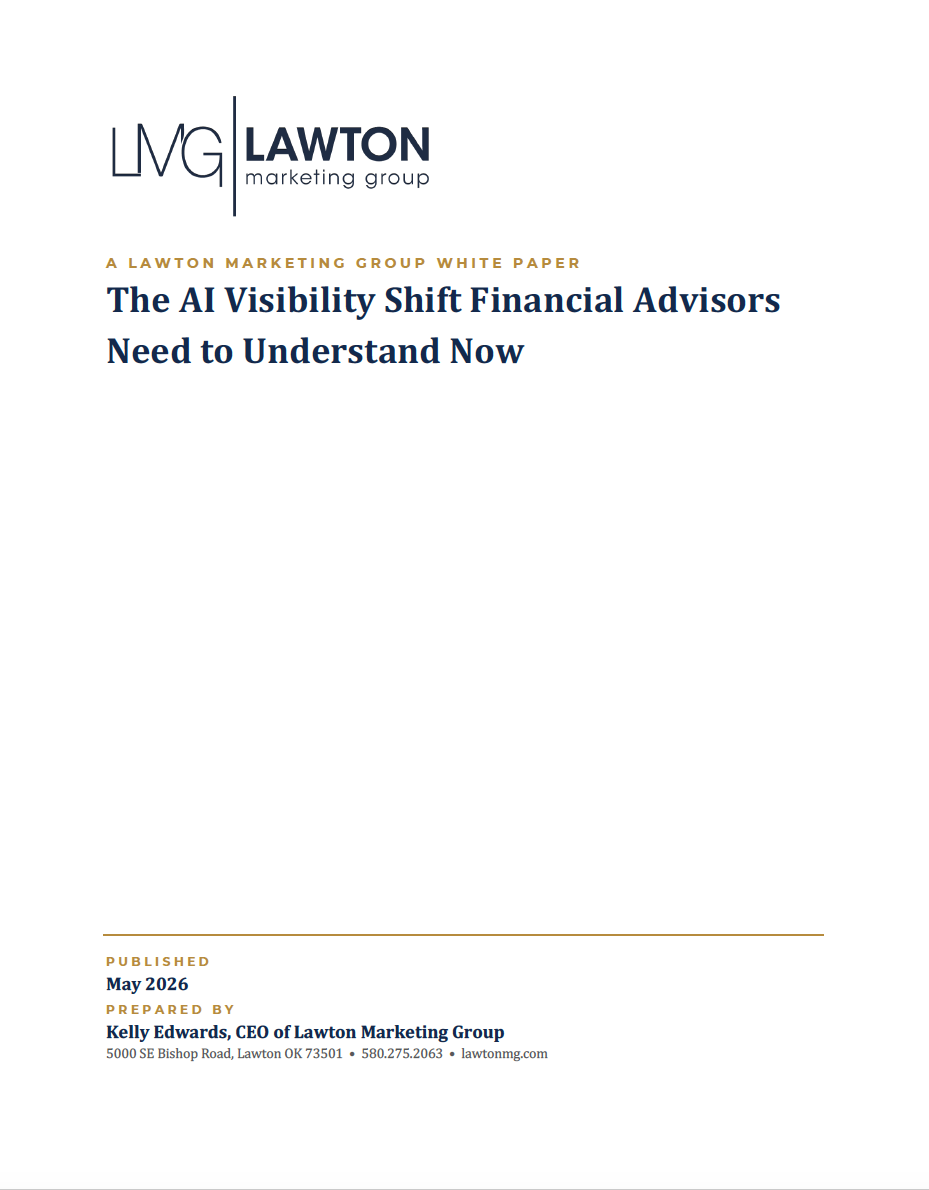
To learn more about what is changing and how to respond, watch the video or read the white paper below. In both, we explain what advisors need to understand about AI-era visibility and how we can help to capture your expertise and turn it into deep, AI-friendly website content.
Read Transcript
GROW YOUR OWN WAY: BUILDING A REFERRABLE, SCALABLE PRACTICE
If you want to grow your financial practice in a meaningful way, you need a well-defined brand identity. That includes certain elements of your visual brand like your logo and color scheme, but it also encompasses your experiential brand.
Your Experiential Brand
What exactly is your experiential brand? In short, it’s your way of operating and serving clients. It’s every process and interaction that defines your unique way of doing business.
Maybe you always offer clients their favorite drink during review meetings. Or maybe you send a branded agenda ahead of every meeting, or you charge a flat fee for planning, or you host an educational event every quarter—those are all elements of your experiential brand.
Collectively, you might call them your “Way” (e.g., “The ABC Financial Way”). For example, part of the “LMG Way” is to send an annual Christmas letter to our clients and other contacts. We do it every year, and everyone on the team participates. It’s part of how we connect with our clients, and it reflects our values as a team that feels like a family.
What makes your “Way” of doing things powerful is when it’s both exceptional and intentional. Just like your visual brand should be consistent and polished everywhere, your experiential brand should have clearly defined rules and parameters.
That means nailing down details like:
- How many times you contact clients during the onboarding process, what those touchpoints are, who sends them, and when they’re sent
- What branded materials you use as you work with clients
- E.g., formatted agendas, a polished capabilities deck, welcome cards, etc.
- How you build relationships with clients
- If you host events—What kind of events? Who is invited? How often?
- If you send gifts—For which occasions? What do you send?
These are just a few examples, but you get the idea. You’re essentially creating a “brand guide” for your operations and client service. The goal is to define exactly what your client experience looks like, so you—and others—can repeat it over time.
Write it down. Share it with the rest of your team. Make sure everyone understands how to implement it. Doing so ensures consistency, which is a key element of referability.
Why Consistency is Crucial
Imagine you visit a restaurant, and the food is phenomenal, and your waiter is highly attentive. You’re excited to go again, and when you finally do, the food is great, but your waiter is borderline rude and gets your order wrong. You give it one more shot, and this time, the waiter is good, but the food is cold.
Will you go back? Probably not. Will you recommend it to your friends when they want a great date-night experience? Definitely not.
Referral-worthy greatness is great every time. Your clients want to be certain you’re going to deliver excellence before they rave about you to a friend or family member—otherwise, they risk looking foolish.
So while loving on clients and exuding polished professionalism may be second nature to you, that doesn’t mean you can rely on your habits alone to build a rave-worthy, referrable practice. The best of us get busy and let details fall by the wayside, especially when those details aren’t part of an established system.
This is especially true as your practice starts to grow. Maybe you’re accustomed to using a branded presentation deck with new clients and they love it, but the junior advisor you hired has never done this, so new clients he brings in don’t get the same experience as other clients. Or worse, he doesn’t know about your branded deck, so he creates his own that doesn’t accurately reflect your brand and everything your practice has to offer.
The more you grow—be it by adding advisors to your team, expanding to new locations, or taking on more clients—the more chances you have of delivering inconsistent service.
But when you have well-defined, repeatable processes in place, your team knows exactly what to do, your clients know exactly what to expect, and it becomes immeasurably easier to scale over time—without you having to do everything yourself or micromanage the process.
Breaking Your Own Rules
Some advisors worry that establishing a company-wide set of “rules” will feel limiting or overbearing, especially if there are several partners in the practice. But defining your “Way” of doing things doesn’t mean telling everyone exactly how to do their job. It means setting a standard so both your team and clients know what to expect.
Plus, not every practice standard has to be implemented exactly the same way. You might decide that your practice’s “Way” of prospecting is for every potential client to receive your firm’s branded capabilities deck, but different advisors can choose whether they want to use it as a presentation or send it to clients before or after their initial meeting.
You can also break your own rules. Maybe you’ve implemented a planning fee for all new clients, but after meeting with a particular prospect, you decide to waive the fee. There’s no harm in doing this, and presenting your fees to that person the same way you would with all new clients—and then waiving it—gives that person a better sense of the value you offer and what they’re getting by working with you.
“Where do I start?”
Establishing your firm’s official “Way” of doing business can feel overwhelming, especially since it involves so many different areas of your practice. The good news is, you probably have a lot of systems and processes already in place—the power is in identifying them, deciding whether they should be amended or updated, and then streamlining them across the practice. When you do that, you position your firm for exponential growth.
Refining a firm’s experiential brand is something we help advisors and teams with through our Growth Planning process, so if you want strategic guidance for establishing your firm’s “Way,” we’d be happy to help.
THANKSGIVING RECIPES FROM THE LMG TEAM
Thanksgiving is Kelly’s favorite holiday of the year (family, food, and football!), and this year, we thought it would be fun to share our favorite family recipes and a few things we’re thankful for! We hope you enjoy, and from all of us – Happy Thanksgiving to you and those you love! Check out our recipe book here…
Birthday Cards: Meaningful Client Touchpoint or Harmful Relationship Killer?
Birthday cards have long been a preferred client-touchpoint strategy for many businesses, and with good reason. A birthday card is a simple way to establish a touchpoint with every client in your business because everyone, of course, has a birthday. Cards are inexpensive, you know exactly when to send each one, and you can even address the envelopes in advance. Plus, they’re thoughtful—who gets physical cards in the mail anymore, right?
But think back to your most recent birthday.
How many pieces of mail did you receive from places like your dentist or bank?
You know the kind—an envelope that looks hand-addressed, a greeting card covered in gender-neutral balloons or fireworks, a printed “happy birthday” message, maybe even a few signatures scribbled on the inside for good measure.
When you got that card in the mail, were you excited?
Did you feel remembered?
Special?
Cared about?
Our guess is… no.
You might have even been a little bit let down, thinking you’d just received a thoughtful birthday card, only to discover it was essentially a marketing piece sent with little thought to you personally.
The card could have been sent with the best intentions, but without any personalization, it can feel almost like a snub—which is the exact opposite effect you want a birthday card to have—especially if you’re a business looking to make meaningful connections with clients.
So if you’re an advisor who wants to grow their practice through relationships that lead to referrals and introductions, we recommend carefully considering your approach to birthday well wishes.
Why Sending Birthday Cards Can Work Against You
With our busy lives and the constant battle for our attention, even a physical, mailed card isn’t enough to feel “special.” If it’s just a generic card with no personal message to the recipient, it feels very… impersonal. Even if it’s been hand-signed.
This is partly because we as consumers recognize it for what it is—a marketing strategy employed in bulk without much thought given to the individual.
Now, there are plenty of marketing strategies that can be employed en masse and still feel thoughtful, or at least interesting and helpful—this just isn’t one of them. The whole point of a birthday wish, after all, is for that individual to feel special, the exact opposite of “one in a mailing list.”
Because of this, sending generic birthday cards can work against you. They send the message that the client wasn’t important enough to acknowledge personally, but that you wanted to make sure they thought of you.
Ouch.
So, should you nix birthday cards altogether?
Not necessarily.
How to Make Birthday Messages Work For You
Keeping the above points in mind, if you write a personalized message on the card, you can hit all the nails on the head—make the client feel important, remembered, and cared about, while also being reminded of you.
The message doesn’t have to be long; it can be one or two sentences. But it needs to show that you actually know this person, and you thought of them specifically while writing the card.
If a hand-written message is too time-consuming to do for every client, then you can send cards only to your top clients, or consider a birthday text instead. A text is super easy to personalize and send, and it’s more thoughtful than a generic card because it shows you took the time to stop in the middle of your day and remember that person. (This is the bare minimum for a birthday message; you can of course personalize the gesture further with a gift, photo, or other ideas you have.)
If you can’t do those things, our advice is to not send cards at all—you’re better off not risking an accidental snub or giving off that “corporate bulk mailer” vibe.
If you’d like to develop a custom client touchpoint strategy for your financial practice, we’d love to help. You can click below or email us to schedule a consultation.
Going Independent: How To Make Your Business Transition Seamless & Positive
The Decision
From time to time, we have advisors reach out who are leaving the company they’re currently with and going independent. This decision to go independent is a big deal, and it requires very intentional communication, branding, and marketing strategies to ensure clients receive the change as positive.
Typically, when we ask them how long they’ve been considering going independent, their response is a couple of years, at least. They know this is a season that’s going to be complicated for their business—it’s stressful, time-sensitive, and it’s a risk for several reasons, not the least of which is that clients aren’t guaranteed to come with you. So it’s not a decision anyone makes lightly.
Regardless of the risks, though, some advisors find that going independent becomes a risk worth taking. And if you’re in that boat, we have some tips to make the process as smooth and positive as possible for you and your clients.
#1: Prepare Your Brand
Some people have existing brands when they transition, and the move is an opportune time to refresh their branded collateral to ensure it’s polished and in line with their brand identity. Others are coming from a strict situation where they’ve had to co-brand or never been allowed to create their own DBA. For these advisors and teams, going independent means building a brand from the ground up for the first time.
Determine What You Need & When
When it comes to branded collateral, everyone needs different things, so when we work with breakaway advisors, we have a meeting to assess where they are now and help them figure out what they need. We tend to approach branding in phases, and Phase 1 includes the items that must be completed and in place before the transition is official. Those items include:
- Name
- Logo
- Website (and domain)
- Website content
- Announcement letter or video
If you use a pitch deck frequently, we also recommend creating or updating this item so it’s ready to go before you announce the transition. Having these pieces in place will ensure your brand looks polished and that you’re ready to share your story effectively throughout the transition.
Why Breakaway Branding is Unique
While we always want to do quick and efficient work for our clients, transition projects usually include hard deadlines and a specific “launch date” we’re working toward.
So, our approach is to outline everything that needs to happen before the launch date and work together to establish an appropriate timeline of deadlines that everyone adheres to. These deadlines are usually pretty strict because there’s generally not any wiggle room for the transition date.
#2: Create a communication plan
Strategic communication is key for any major business transition. You want your clients to know that the move is positive and avoid creating worry or uncertainty, so planning ahead for how you tell people is essential.
How To Announce Your Business Transition
Some of our clients create an announcement video, some share the news via a letter or branded email, and some do both. Whichever you opt for, you also need to plan to call your top clients and let all your other clients know they’re free to call you, email you, or stop by if they have questions, concerns, etc. Once all your clients have been informed, you should also share the news on your social media platforms. Be sure to clear your schedule for a week or two post-transition to focus on communicating with your clients and putting everyone’s minds at ease.
Minimize Worry & Confusion
When announcing your move, the important thing is to avoid the temptation to overexplain the reasons you’re leaving your current company. When people see a long video or letter, they’re a lot less likely to watch or read it, and they’re a lot more likely to worry, panic, speculate, and reach out to you and ask, “What is this about?”—which is exactly what you’re trying to avoid.
The best thing to do is keep it short and simple, then direct clients to another source for more information, like a Q&A page on your website, and invite them to contact you directly if they have additional questions. It’s also good to create some agreed-upon language for the rest of your team, so everyone is communicating the same message.
A few more points for your announcement verbiage, be it a letter or video script:
- Make the point that the transition is so you can best serve your clients
- Highlight all the things that will not change (excellent service, your team, etc.)
- Provide quick and simple next steps (“Watch our Q&A video,” “Be on the lookout for XYZ email,” etc.)
Double-Up Your Announcements
If you are also rebranding or creating a new brand, this is the perfect time to tell clients. In the same message you announce that you’re going independent, you can add, “We’ve also rebranded our practice… Check out our new website… etc.” which makes both announcements seem like not such a huge deal (in a good way).
#3: Reinforce Normalcy
Finally, once you’ve made your big announcement and spent a few weeks answering questions, talking to clients, and transitioning accounts, send some kind of communication to show clients that everything is “business as usual.” That might be your regular monthly newsletter or something as simple as an email from you saying, “I saw this article and thought it would be great to share with our clients—hope you enjoy!” This kind of communication reinforces the idea that the confusing period of change is over, and everything is back to normal.
#4: Don’t Go It Alone
Whatever the reason for a move, transitioning one’s practice can be incredibly stressful, especially with a tight timeline, and you’re going to need a team of professionals on your side. When we work with breakaway advisors (and all our clients, for that matter), our goal is to take as much as possible off their plate and minimize stress any way we can.
If you see a transition in your business’s future, we’re happy to walk you through the process and help you prepare your practice for a new season of excellence.
What Does Your Bio Really Say About You
Having worked with many of the nation’s top advisors over the years, one thing we’ve learned is that when a prospect visits a financial advisor’s website, the page they spend the most time on is the Team page.
Why?
Because as we’ve said before, advising is a personal business. Even when an advisor is part of a DBA, people are referred to him or her by name. So when prospective clients visit your website, they’re there to vet you. They might check out some things about the company as well, but they are always going to do their due diligence and vet the individual advisor. They want to be sure you have the ability to help them with whatever they need.
When it comes to vetting, every prospect cares about different things. For some, education and designations are really important; others don’t care at all. It’s the same with awards. Some prospects want to know more about your personal life; others don’t. That’s why a comprehensive bio is crucial for advisors. You want to be sure to include everything someone may want to know about you. And because of that, this is the one place in your website content where the “less is more” rule does not apply. (If you’re worried about it being too long, don’t worry—we have a solution for that.)
The bottom line is, you need to make a great impression with your bio. To do that, you need to answer two key questions, and you need to avoid several common mistakes.
2 Key Questions to Address With Your bio
When prospects click on your bio, they are wanting to know the answer to two key questions:
- Does this person have the knowledge and experience I need in a financial advisor?
- Will I like them and enjoy working with them?
The first question is the most straightforward. Prospective clients need to know if you work with people like them, and they want confidence that you’re great at what you do. To that end, you want to include information about what areas of planning you specialize in, how long you’ve been in the industry, and what designations, licenses, degrees, and even awards you have.
That said, many advisors fear that detailing their knowledge and accolades will make them sound salesy or braggy. But reading your bio is part of the client’s vetting process, and they’re looking for reasons to say yes or no to working with you—so if you have something impressive to share, share it. After all, you don’t worry about sounding braggy on a resume, because it’s the appropriate place to share all the high points about you; the same is true of your bio.
Plus, website bios are traditionally written in the voice of the company (e.g., “Mark has been serving clients for more than 30 years”), which allows you to share all the reasons a client would want to work with you without sounding self-important.
The second question, “Will I like the person and enjoy working with them?” is a little less straightforward to answer, but it’s also crucial to a compelling bio. Your bio should have some personality; it should give prospects an idea of the type of person you are. Much of this can be accomplished by sharing information about your personal life, like your hobbies and family, but there are ways to lift the veil even if you want to keep things a little more private (more on that below).
The key is to reveal some things about yourself that go beyond your expertise as an advisor. Something that will give the reader an idea of the kind of person you are, like whether you’re comfortable cracking a few jokes in a meeting or you keep things straightforward and professional.
Segmenting Your Bio
Sound like a lot of information to fit into one bio? It is. But that doesn’t mean it’s overkill; different people care about different things, so the best practice is to leave nothing out. To ensure it’s not overwhelming for the reader, we recommend segmenting it into several sections so they can skim and quickly find what they’re interested in. Here are some section examples:
- Areas of Expertise
- Clients Served
- Education & Designations
- Awards & Accolades
- Community Involvement
- Personal Interests
- Photo Gallery
You can use different sections based on what kind of story you want to tell and the kind of information you share, but these are some of the common categories. Here is an example of a team that has segmented their bios.
4 Mistakes to Avoid When Creating Your Bio
Now that you know the elements of a great bio, here are a few things to avoid:
- Outdated Information
Review your bio at least once a year and update information as necessary (new designations or awards, a new baby in the family, etc.). It’s also a good idea to include all numerical information in an evergreen style. So instead of saying you’ve been in business for 31 years (which will be 32 next year), say “more than 30 years.” Instead of listing your kids’ ages, say they are “young,” “in grade school,” “adult children,” or don’t specify at all.
- Grammatical Errors
If you’re writing your own bio, always have one or two people proofread it. Even if you have someone else write it, it’s a good idea to have a second and third set of eyes check for misspelled words, missing punctuation, and other errors. Small mistakes like this can give the impression that you’re sloppy or don’t pay attention to details.
- Sparse Content
To reiterate, most prospects want to know as much as they can about you, so if you have a lot to say, say it! If you’ve been in business for more than 30 years and you’re the principal, a few sentences won’t cut it. Even if you’re not someone who focuses on getting lots of designations or awards, you can share about your approach to the business and what your experience has taught you. If you work with lots of business owners or retirees, say a little about why you’re a great fit for that type of client.
- Lack of Personality
In our professional opinion, the more you share about yourself as a person, the better. It helps people get to know you and connect with you, which helps them trust you. Talk about your family and what you love to do together; include pictures of your dog or your favorite vacation moments; mention a charity you’re passionate about. In short, if it’s lighthearted (i.e., not politics) and important to you, share it.
Of course, everyone has their own privacy threshold, and that’s fine, so do what’s comfortable for you. If you want to keep things a little more surface-level (but still personal), you can include a section of “Fun Facts” with details like your favorite restaurant or sports team, an impactful book you’ve read recently, or a movie you could watch over and over again. Here’s an example of a team that has implemented this concept really well.
Upgrade Your Bio
Want help crafting a thorough, compelling bio? We’d love to help! Just give us a shout by clicking the Consultation button below.
Why Community Involvement is Good for Your Business
One common thread among the advisors we work with is that they’re passionate about serving the communities in which they live and do business. Their desire to help others extends beyond the work they do with clients and into other areas of their life.
Our agency is the same way—we love the opportunity to serve, and it’s important to us to make a positive impact on others. And while we’d volunteer our time for this reason alone, this focus on giving back as a company is also good for business.
Here are some ways serving others as a team can enhance your business:
Serving Together Develops Your Team
At LMG, we care very much about our employees as whole people, and this perspective has helped us cultivate a team of genuine, loyal, and passionate team members. Our company is like a family to us, and that’s largely because we’ve very intentionally poured into our culture.
Our work is the common thread that brings us together, but we care about more than the bottom line, and it shows. We invest in activities like fitness challenges and company retreats (aka “family reunions”), and these initiatives all help us grow closer as a team. It’s the same with serving in the community—when we attend events like the United Way Day of Caring, it builds camaraderie and continues to make the statement to our team that we are invested in them as people—and their community. We know the value in serving others, and we want to help cultivate that experience for them.
What if my team members aren’t local:
Only about 75% of our team is local, and the same can be said for many of our clients, so you may not have the opportunity to bring your whole team together and volunteer somewhere—but don’t let that stop you from participating in charitable efforts with your team members who are local. There are also creative ways to get your remote team involved, like participating in a virtual 5k to raise money for a charity.
Prioritizing Serving the Community Positions Your Company as a Desirable Workplace
Generation Z is permeating the workforce, and these individuals have made it clear that they care about the impact their job has on the world at large. They want to make a difference, both in their profession and in their life in general—and they want to know that their employer is similarly committed to making a positive change.
Devoting time to serving in your community or fundraising for a charity is another way to create a fulfilling work environment. Today’s workforce is motivated less by the “what” and more by the “why” and “how”—why they do what they do, why their job matters, and how they can make a difference through their jobs. So giving your employees opportunities to serve or benefit a cause they’re passionate about can be a great way to help recruit (and retain) driven young people for your company.
It’s Good to Do Good.
The first two reasons are for the good of your people and your business—it feels good to give back and know you’re making a difference, and it benefits your company to spend time together cultivating a close-knit, motivated, and fulfilled team. But for our agency, the most important element is that serving others is part of who we are. We’ve been given unique talents and resources, and we want to use them to help the community in which we live.
Our agency often does pro bono work for churches and local nonprofits, whether that’s building websites, consulting, designing different pieces, or helping promote an event. Our CEO and co-owner Kelly has served on the local school board and is the former President of the Lawton Public School Foundation board. She has participated on the local United Way board for about four years and is now the Vice President.
And we don’t do any of this to acquire new clients—most of our clients are in other states, and they’re not impacted by our local efforts to give back. We serve those around us because we believe it’s important to recognize and address the needs in our community. As many of our clients also say, “We are blessed to be a blessing.”
Naming Your Financial Practice: What You Need to Know
Over the course of their careers, many advisors find themselves going through a branding or rebranding process more than once. Sometimes it’s because they’re taking on a partner and launching a new name; they might be breaking away from a broker-dealer and going independent; and other times it’s because they’re in the final 10-15 years before retirement and they want to create an identity that’s more attractive to a wider market.
Whatever the reason for a rebrand, naming your financial practice is a big decision.
The moniker you choose will be used in just about all your company’s collateral (on your business cards, your website, social media profiles, email signature, etc.), and it’s how clients will come to recognize your brand for years to come. You’ll use it when you introduce yourself, and your clients will say it to their friends and family every time they refer you to someone.
So naturally, you want it to be good great.
Yet it is this very desire for greatness that sometimes sends advisors down a frustrating path.
Why Some Advisors Get Frustrated When Trying to Choose a Name for Their Practice
Let’s pivot for a moment and talk about your brand story.
Your brand story is incredibly important. It tells people why you do what you do, how you’re different, how you can help them, and why they should trust you. It’s one of the foundational elements of your brand, and it’s the emotive powerhouse that inspires people to reach out to you once they’ve been referred to you. Your story (all of which should be told on your website) should bleed into the content on your social media, in your pitch deck, and even in your spoken language.
But (contrary to popular belief) it does not have to influence your company name.
Your name is only a few words, so it’s not the right place to tell your brand story. Your name can have meaning; it can tie into your story—but try not to make that a prerequisite before you explore all your options.
A lot of times, advisors and teams get bogged down with the idea that their name needs to tell part of their story. They want it to reflect the difference they make in people’s lives or the special way they approach the planning process.
And while a meaningful name is cool, it’s not necessary. In fact, sometimes looking for a meaningful name that’s also available from a trademark, competitor, and domain standpoint just makes it a lot more challenging to find one.
So consider all your options before you get caught in a (very well-intentioned yet potentially frustrating) rabbit hole in your search for a name. Maybe your name doesn’t have to have a super-inspired backstory or clever explanation. Maybe it’s just something you love that people will remember and repeat for generations.
There are lots of different name types, and no one is better than the other. Here are some examples to get your wheels turning:
Types of Business Names
Name-Names
Example: Smith & Jones Financial Group
Classic and simple. The preferred style of attorneys, CPAs, and many financial professionals. A Name-Name could come from your last name, middle name, maiden name, initials—anything that involves your name.
While at first highly personal, these name types can also evolve into some of the most well-known and iconic brands. Think Ford, Chanel, Johnson & Johnson, Harley-Davidson, Hermès—they were just names. Now they are symbols.
Location Names
Example: Main Street Financial Group
Another classically simple approach is to name your business for its location (or even a location that’s just meaningful to you). That could be a street name, city, beachfront, anything. We have several clients who have taken this approach, and it works well. Oh, and there’s our agency—Lawton Marketing Group (known as LMG to our entire team and many of our clients).
Some well-known examples include: Kentucky Fried Chicken, American Airlines, Abbey Road Studios, Adobe (named after Adobe Creek in Los Altos, California).
Made-Up Names
Example: Veridian Wealth Advisors
Some of the most iconic brands have names that mean nothing at all. Rolex, Kodak, Spotify, Oreo, Hulu, Zara—these aren’t even real words. Starbucks, Firestone, Goodyear—they might be comprised of real words, but do they make you think of coffee or tires? (Well, they do now.)
Meaningful Names
Example: Marathon Wealth (because wealth management is a marathon, not a sprint)
Of course, Name-Names and Location Names can be meaningful, but for our purposes, “Meaningful Names” are those derived solely for their meaning. These names relate to the company’s mission, approach, vision, clients served, or something else relevant to the brand story.
Meaningful names have several variations:
- Straightforward (e.g., Dove, a word that evokes purity and peace)
- Translated (e.g., Volkswagen, which is German for “people’s car”)
- Combined (e.g., Netflix = internet + flicks/flix)
There are lots of ways to play with meaningful name ideas by combining translated words, using well-known names from history or mythology, including numbers, shortening a real word—there are endless possibilities.
Some other well-known examples include:
- Sephora (which, according to Sephora’s X account, is a translated and combined word that comes from the Greek sophus, meaning beauty, and Zipphora, Moses’s wife who was known for her beauty)
- Nike (the Greek goddess of victory)
- Groupon (group + coupon)
- Caterpillar/CAT (named for the way the machines move)
- Cisco (short for San Francisco, where the company was founded)
- Airbnb (a nod to when the company’s founders rented out air mattresses as part of their makeshift bed and breakfast)
- Lego (from the Danish phrase, leg godt, meaning “play well”)
Something to note about these very well-known and meaningful names is that most people don’t know what they mean offhand. Some (like Netflix and Airbnb) are relatively self-explanatory, but many of them are memorable simply because the company itself is popular.
Which brings us to a very important point: You bring meaning to your business’s name, not the other way around.
Much of the power of a name is simply in its familiarity. So while it’s fun if your company’s name alludes to some special meaning, it’s not essential. Beyond being available from a trademark and domain standpoint and being unique enough that you’re not likely to be confused with a competitor, the most important factors are that your name is:
- Easy to say
- Easy to spell
- Sounds good
It’s that simple.
Need Help Finding a Name?
The concept for developing a name may be simple, but the complete process is not. Once you find some ideas you love, there’s still a lot of vetting to be done. If you want help with your DBA naming process, let us know by clicking the button below. We can help you from brainstorming all the way to finding a good domain, or we can help you vet some name ideas you already have in mind.
3 Reasons You Need A Welcome Packet For Your Financial Practice
“You don’t get a second chance to make a first impression.”
It’s true, and perhaps twice as important for financial advisors than the average business. A client’s initial impression of you and your firm is incredibly important for two reasons:
First impressions set the stage for how we view a person (or business) for the rest of the relationship.
If your new neighbor says something to you that rubs you the wrong way, you’re likely to be wary of them for quite a while. If you order a shirt from a company and they send you the wrong one and refuse to correct the issue, the likelihood you’ll do business with them again is slim. Because from that point on, confirmation bias kicks in, and you’ll notice everything that confirms your already negative opinion—and ignore most evidence to the contrary.
But the opposite is also true. When someone listens intently to you or pays you a genuine compliment, you think of them as a kind person. If a business goes out of their way to make your life easier and deliver amazing service, you remember that experience—and rave about it—years later.
As an advisor, a client’s first impression of you is a culmination of things—the first time they contact you, the first time they see your office, do a Zoom call with you, receive paperwork from your practice—all these things create their first impression of your business. If you appear polished, attentive, and on top of your game, that’s how the client will view you from that moment on. But if your communication is sporadic or working with you is a bit of a hassle—you’re missing a wealth of opportunity.
The first 6 months of the client relationship is your best opportunity to get referrals.
The first several months you work with someone are incredibly impactful to that person. You’re showing them opportunities available to them, finding solutions to their chronic financial problems, giving them clarity about their nagging questions, and getting their life organized. You are actively changing the way they think about their money and their future, and that’s a big deal.
When something great happens to you, don’t you want to tell people about it?
And the more polished, impressive, and helpful you are, the more likely clients are to tell others about their amazing experience working with you.
That’s why the first six months are a critical time to knock your clients’ socks off. If you want a powerhouse branding tool to get you started, a Welcome Packet is a great place to start.
What is a Welcome Packet for a Financial Practice?
When someone onboards into your firm, there are lots of documents to keep track of, emails to send, even new names to learn. A welcome packet brings all that information together into one polished, branded document. It’s a booklet that officially welcomes someone to your client family and includes all the relevant information they need to know, such as…
- Account login details & instructions
- A team directory
- A list of documents they need to send you
- What they should expect throughout the planning process
- Who your firm is and what you value (this being a reminder, not new information)
- Etc.
A welcome packet like this serves several purposes—all of which increase your referability.
1) Make a Great Impression
As we said, the first six months of the client relationship are critical to making a great impression. The more impressive you are in this season, the more likely clients are to refer you to others. A welcome packet can reinforce your brand messaging, reminding clients why they chose to work with you and how you’re different from other advisors. When you give them a well-designed, branded booklet that has everything they need, it shows them you’re on top of things, and you’re going to make their life easier. It shows them you know what you’re doing, and they’re in great hands.
2) Create Order & Simplicity
If you opt for the traditional onboarding method—sending several emails and forms over the course of who-knows-how-long—the chances of your team or the client forgetting something, losing something, or missing something are much higher. Beyond that, it’s just messy. No one needs more complexity in their lives, especially not busy, successful people. Putting everything in a welcome packet ensures you and the client have all the relevant information you need in one place.
3) Become a great Gifter
If you want to take things to the next level, you can also use your welcome packet to build deeper relationships with clients. In addition to the necessary paperwork, include a “Favorite Things” checklist. This is a questionnaire where you ask clients about their favorite hobbies, places to visit, food and drink, etc. Later, you can use that information to send them thoughtful gifts or treat them to their favorite snacks when they come to your office.
If you want to go a step further, you can also send a welcome gift to new clients. Make it something high quality and name-brand (e.g., a Stanley cup), and include your logo. Pack it in a branded box along with your welcome packet, and you have a rave-worthy welcome kit.
Upgrade Your Onboarding Experience
Need help designing your welcome packet? Wondering if your onboarding process needs an overhaul? We’d love to help! We’ve worked with countless advisors to fine-tune their client experience and create impressive, branded materials for their practice. Just send us a message and let us know what you’re looking for!
- 1
- 2
- 3
- …
- 9
- Next Page »